This article may contain affiliate links. We may earn a small commission at no extra cost to you if you make a purchase through these links.
Fall Detection Wearables 2026: Apple Watch vs. Alert Devices
Apple Watch caught 7 of 10 simulated falls. Medical Guardian's MGMove caught 9. Dedicated devices still beat smartwatches — here's the 2026 accuracy data.

Independent testing on simulated falls found the Apple Watch detected 7 of 10 falls, while Medical Guardian's dedicated MGMove device detected 9 of 10 and its MGMini Lite detected 8 of 10 — a real, measurable accuracy gap that matters enormously in a category where the entire point is reliably summoning help during a genuine medical emergency. The core lesson for 2026: general-purpose consumer smartwatches and purpose-built medical alert devices are not interchangeable, even though both now market "fall detection" as a headline feature.
The technology has also genuinely improved — AI-enhanced sensors across the category reduced false alarms by approximately 30% in 2026 compared to earlier generations, with newer devices analyzing both "pre-fall" and "post-fall" movement patterns rather than relying on simple impact-detection thresholds that trigger on any sudden motion.
Why general smartwatches underperform dedicated medical alert devices
Apple Watch's fall-detection algorithm is fundamentally tuned for general activity tracking rather than medical-specific fall patterns — a design choice with real consequences in both directions. Active users can experience false alarms triggered by vigorous exercise or sudden movement that the algorithm misreads as a fall, while conversely, low-impact falls — often the exact type an elderly user with reduced bone density or balance issues actually experiences — may not trigger detection at all, since the algorithm's threshold is calibrated for the broader population rather than specifically for elderly fall biomechanics.
This is the structural reason a dedicated medical alert device consistently outperforms a general-purpose smartwatch on fall-detection accuracy specifically: purpose-built devices like Medical Guardian's MGMove and MGMini Lite are engineered and tuned specifically around elderly fall patterns as the primary design target, not a secondary feature layered onto a broader fitness-tracking platform.
2026 detection-rate comparison
| Device | Type | Falls detected (of 10 simulated) | Notable feature |
|---|---|---|---|
| Medical Guardian MGMove | Dedicated medical alert watch | 9/10 | Touchscreen, two-way talk, top-rated in 2026 testing |
| Medical Guardian MGMini Lite | Dedicated medical alert device | 8/10 | Compact form factor |
| Bay Alarm Medical SOS Smartwatch | Dedicated medical alert watch | 8/10 | Optional AI-based fall detection that learns individual movement patterns to reduce false alarms |
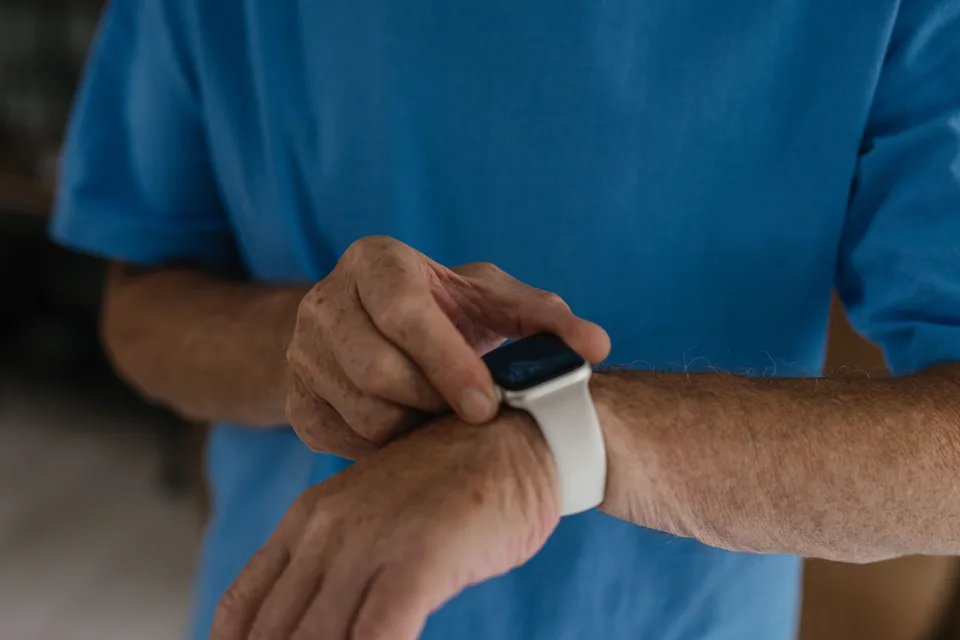
| Apple Watch (Series with fall detection) | General-purpose smartwatch | 7/10 | Broadest ecosystem integration, not medical-specific tuning |

Apple Watch vs. Life Alert — neither is the complete answer
The comparison between Apple Watch and Life Alert (the original, most brand-recognized medical alert company) is genuinely instructive about the category's trade-offs. Independent buyer guides consistently conclude that neither is ideal for most users — Apple Watch simply isn't specialized enough to function as a dedicated medical alert system despite its fall-detection feature, while Life Alert is comparatively expensive and, notably, lacks automatic fall detection entirely, instead relying on the user manually pressing a button — a serious limitation given that the population most likely to need the service (elderly users experiencing a fall that causes injury, confusion, or unconsciousness) is exactly the population least likely to be able to reliably press a button after a fall event.
The 2026 AI improvement — pre-fall and post-fall movement analysis
The most meaningful technical advance in 2026 is the shift from simple impact-threshold detection (did the device experience a sudden deceleration consistent with hitting the ground?) to genuine movement-pattern analysis spanning both the moments before and after a potential fall. AI-enhanced sensors analyzing this fuller movement context — gait instability leading into an event, followed by the specific post-impact movement pattern of someone who has actually fallen versus someone who set the device down forcefully or experienced a different kind of sudden motion — have driven the roughly 30% reduction in false alarms across the category in 2026.
Bay Alarm Medical's SOS Smartwatch exemplifies this trend directly, offering an optional AI fall-detection mode that specifically learns an individual user's normal movement patterns over time, using that personalized baseline to distinguish genuine falls from the user's ordinary daily activity with meaningfully better accuracy than a generic, population-wide detection threshold.
How to choose
This mirrors the accuracy-versus-marketing-claims pattern we've documented across wearable health tech, including our wearable ECG comparison — general-purpose consumer devices and purpose-built medical devices frequently share a marketing category ("fall detection," "heart monitoring") while delivering meaningfully different real-world accuracy for the specific clinical use case at hand.
- Elderly user with genuine fall risk, needs the most reliable automatic detection: Medical Guardian's MGMove — the highest tested detection rate (9/10) plus touchscreen and two-way talk features designed specifically for this use case.
- Wants AI-personalized detection that adapts to individual movement patterns: Bay Alarm Medical's SOS Smartwatch, whose optional AI mode learns the specific user's baseline movement to reduce false-alarm frequency.
- Already deeply invested in Apple ecosystem, wants a single device for both fitness and basic safety: Apple Watch is a reasonable secondary safety layer, but should not be relied upon as a primary medical alert solution given its meaningfully lower tested detection rate and non-medical-specific tuning.
- Values name recognition and simplicity over automatic detection: Life Alert remains an option, but the lack of automatic fall detection is a genuine limitation worth weighing carefully against the population most likely to need the service.
This category connects directly to the broader ambient-sensing elder-care technology we covered in ambient elder-care sensing — wearable fall detection and passive in-home ambient monitoring are complementary rather than competing approaches, with wearables covering incidents outside the home and ambient sensors covering the much larger share of falls that occur inside it.
The bottom line
Fall-detection technology genuinely improved in 2026 through AI-driven pre-fall and post-fall movement analysis, cutting false alarms by roughly 30% across the category. But the accuracy gap between general-purpose smartwatches and dedicated medical alert devices remains real and measurable — Medical Guardian's purpose-built devices detected 8-9 of 10 simulated falls versus Apple Watch's 7 of 10 in the same testing. For any user with genuine elevated fall risk, a dedicated medical alert device tuned specifically for elderly fall biomechanics remains the more reliable choice over a general-purpose smartwatch, regardless of how polished that smartwatch's broader ecosystem and fitness-tracking features are.
Frequently Asked Questions
Does Apple Watch fall detection work as well as dedicated medical alert devices?
Not quite — independent testing found Apple Watch detected 7 of 10 simulated falls, compared to 8-9 of 10 for dedicated medical alert devices like Medical Guardian's MGMove and MGMini Lite. Apple Watch's algorithm is tuned for general activity tracking rather than elderly-specific fall biomechanics, which can result in both missed low-impact falls and false alarms during vigorous exercise.
Which fall-detection device has the highest accuracy in 2026?
Medical Guardian's MGMove tested the highest at 9 of 10 detected falls in simulated testing, followed by both the MGMini Lite and Bay Alarm Medical's SOS Smartwatch at 8 of 10. Apple Watch tested lowest of the compared devices at 7 of 10, reflecting its general-purpose rather than medical-specific design.
Does Life Alert have automatic fall detection?
Life Alert traditionally relies on the user manually pressing a button rather than automatic fall detection, which is a meaningful limitation given that elderly users experiencing a fall causing injury or confusion may not be able to reliably press a button afterward. This is a key differentiator versus devices like Medical Guardian's MGMove or Apple Watch, both of which offer automatic detection.
How much have AI improvements reduced false alarms in fall-detection devices?
AI-enhanced sensors analyzing both pre-fall and post-fall movement patterns reduced false alarms by approximately 30% across the fall-detection category in 2026, compared to earlier-generation devices relying on simpler impact-threshold detection that could misinterpret sudden movements like setting a device down forcefully as an actual fall.
Should an elderly person rely on a smartwatch or a dedicated medical alert device?
For anyone with genuine elevated fall risk, a dedicated medical alert device tuned specifically for elderly fall biomechanics (like Medical Guardian's devices) is the more reliable choice based on independent testing accuracy. A general-purpose smartwatch like Apple Watch can serve as a reasonable secondary safety layer for users who want combined fitness and basic safety features, but shouldn't be relied upon as the sole safety net given its meaningfully lower tested detection rate.
Enjoying this article?
Get more strategic intelligence delivered to your inbox weekly.
Enjoyed this article?
VentureBeast.Tech is independent and reader-supported. If this saved you time, you can buy us a coffee — it keeps the research deep and the site ad-light.
Support us on Ko-fi


Comments (0)
No comments yet. Be the first to share your thoughts!