This article may contain affiliate links. We may earn a small commission at no extra cost to you if you make a purchase through these links.
Ball-Tracking Wars: Hawk-Eye, TrackMan, Sportvision
Sportvision pioneered it. TrackMan radar replaced it. Hawk-Eye cameras now own every MLB and NFL stadium. The 20-year arms race is essentially over.

Three companies have controlled the way professional sports see the ball for the last two decades: Sportvision, the original computer-vision pioneer; TrackMan, the Danish radar specialist that owned MLB stadiums from 2015 to 2020; and Hawk-Eye Innovations, the Sony-owned camera-array system that displaced them both and now powers the 2026 ABS Challenge System. The arms race is essentially over — Hawk-Eye won — and the next round will be fought on a different battlefield.
Each generation of ball-tracking technology lasted roughly five years before the next one arrived with a better answer to the same question: where was that ball, exactly, and what should the league do about it? Sportvision invented the category in the late 1990s with the yellow first-down line and FoxTrax glowing puck. TrackMan rebuilt MLB's pitch-tracking on 3D Doppler radar in 2015. Hawk-Eye finished the job with camera arrays and machine vision in 2020. Each shift was driven by the same forces: more cameras, more pixels, more processing throughput, and a league office willing to pay for verifiable ground truth on plays the human eye keeps missing.
This is the brief history of how each company won and lost its decade — and what comes next now that the camera array has eaten the radar.
Generation 1: Sportvision and the dawn of broadcast augmentation
Sportvision shipped FoxTrax — the glowing hockey puck — in 1996, and the yellow first-down line in 1998. These were broadcast augmentations, not officiating tools. The technology used a mix of in-camera sensors and hand-keyed perspective math. By the early 2000s Sportvision had pivoted into MLB through PITCHf/x, the league's first computer-vision pitch tracker, installed in every park by 2008. The product became the data infrastructure for an entire generation of pitch-tracking analysis, from baseball blogs to MLB Network broadcasts.
Sportvision's HITf/x followed in 2009, capturing batted-ball launch angle and exit velocity — the metrics that later became the foundation of the launch-angle revolution in talent scouting. For roughly seven years, PITCHf/x and HITf/x were the canonical ground truth for MLB pitch and batted-ball data, licensed across every team's analytics department and the broadcast partners.
The catch: Sportvision was a computer-vision house in a pre-deep-learning era. Their cameras and calibration were good for the 720p HD broadcast era; they didn't scale gracefully when 4K and high-frame-rate became table stakes. By 2014 MLBAM was actively looking for a replacement, and a Danish radar company most baseball fans had never heard of was about to take the contract.

Generation 2: TrackMan and the radar interregnum
TrackMan was founded in 2003 by brothers Klaus and Morten Eldrup-Jørgensen and radar engineer Fredrik Tuxen. The company built its name in golf — every PGA Tour event tracks ball flight on TrackMan radar — before pivoting to baseball in the mid-2010s.
The MLB rollout was fast. TrackMan installed in all 30 MLB stadiums and more than 80 minor league ballparks by 2015. In 2017, the league formally retired PITCHf/x and made TrackMan the official Statcast tracking source. The radar approach had advantages over Sportvision's cameras: it tracked the ball through pitch and batted flight on a single sensor stack, with less calibration drift between parks. It was, for three full seasons, the most accurate ball-tracking technology any sport had ever deployed.
The Achilles heel was bandwidth — radar resolves a moving object well, but it does not resolve context. A radar return tells you where the ball is, not where the catcher's glove is, where the runner's leading foot is, or whether the batter's elbow crossed the strike-zone vertical line. As baseball analytics matured, the league wanted player-tracking on the same data fabric as ball-tracking. Radar could not deliver that, and TrackMan never built the camera complement to compete with what came next.
Generation 3: Hawk-Eye, Sony, and the camera-array consolidation
Sony acquired Hawk-Eye Innovations in March 2011 for a reported £15–20 million — a price that looks like a giveaway in retrospect. Hawk-Eye was already established in tennis (Wimbledon adopted it in 2007) and cricket (Test match adoption beginning in 2001), and after the Sony acquisition, the company aggressively expanded into football, hockey, and eventually baseball.
MLB replaced TrackMan with Hawk-Eye across all 30 stadiums for the 2020 season. The system uses 12 high-frame-rate camera installations per ballpark, with computer vision tracking the ball, every player, and the bat simultaneously. This is the technical foundation that made the 2026 ABS Challenge System possible — without per-player, per-pitch 3D positional data, the strike zone could not be enforced relative to each batter's height. Radar alone could never have produced the rule.
The Hawk-Eye footprint outside baseball is even larger. In 2025 Sony announced Hawk-Eye would handle line-to-gain measurements for the NFL — replacing the chain gang for first-down rulings beginning in the 2025 season. Super Bowl LX used 175+ Sony cameras and Hawk-Eye tracking for the broadcast. The SEC announced a Hawk-Eye-powered ABS pilot for the 2026 conference baseball tournament. Tennis, cricket, soccer (semi-automated offside), field hockey, and now baseball and American football all run on the same vendor stack.
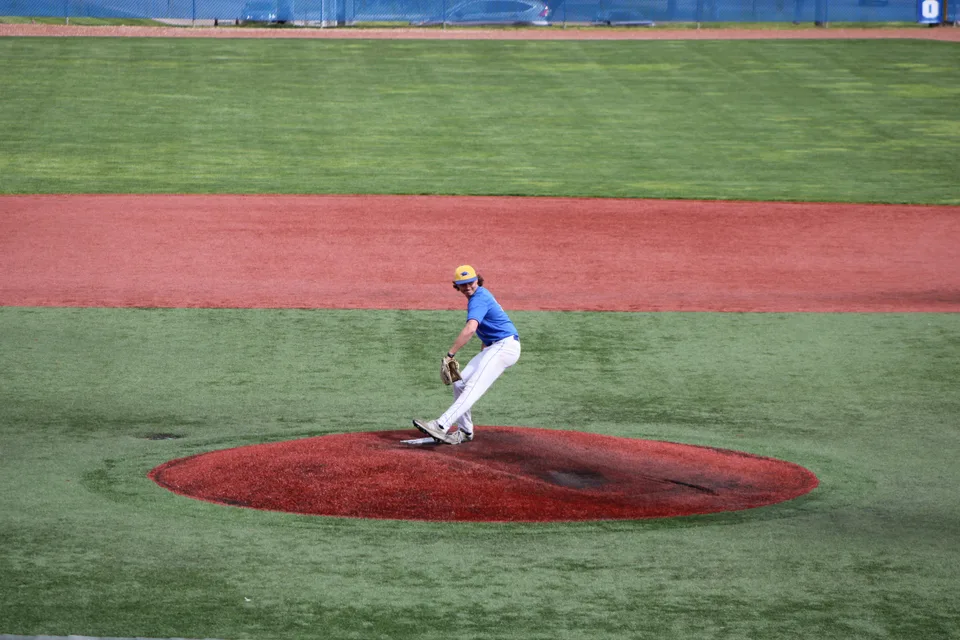
Side-by-side: what each system actually measured
| System | Years in MLB | Core sensor | Tracks ball? | Tracks players? | Tracks bat? |
|---|---|---|---|---|---|
| PITCHf/x (Sportvision) | 2007–2017 | 2-camera stereo | Yes | No | No |
| TrackMan | 2015–2020 | 3D Doppler radar | Yes | No | Partial |
| Hawk-Eye | 2020–present | 12 camera array | Yes | Yes | Yes |
The arc is consistent. Each generation tracked more objects with more accuracy and more context. The PITCHf/x era gave us pitch location. The TrackMan era added launch angle and exit velocity. The Hawk-Eye era added every-player positioning, bat path, swing kinematics, and the ground truth that lets a system like ABS exist.
What happens next — the AI-extracted insight layer
Hawk-Eye won the ball-tracking arms race, but it did not win the analytics layer on top of it. The next decade's competition is about who reads the Hawk-Eye feed best — and that is an open field.
Three vectors are already visible. First, real-time biomechanics extraction: Hawk-Eye's raw output is positional data per camera frame. Companies like Driveline Baseball, KinaTrax, and Reboot Motion are building proprietary models that turn that positional data into pitcher-injury risk scores, hitter swing-fault diagnostics, and pre-pitch tipping detection. The Hawk-Eye contract gives the league the data; it does not give the league the model.
Second, generative broadcast augmentation. The same data that powers ABS can drive auto-generated camera angles, real-time strike-zone overlays, and tactical visualizations for casual fans. ESPN and Apple TV+ are already shipping these on baseball, and Netflix's Giants-Yankees opener carried the most aggressive auto-augmentation of any MLB broadcast to date — every pitch annotated, every challenge animated.
Third, cross-league portability. Hawk-Eye's biggest moat is that the same vendor now runs measurement in baseball, football, tennis, cricket, and soccer. League officiating tech is consolidating onto one platform faster than anyone predicted in 2020. The same model the NFL uses to detect a first down can be retrained for soccer offside calls or hockey goal-line decisions with surprisingly little incremental data.
The bottom line
The next great sports-tech company will not build a competing tracking system. It will build the AI layer on top of Hawk-Eye that no league or single team can build alone. The hardware war is over; the model war is just starting. Watch for acquisitions on the analytics side — Stats Perform, Sportradar, Genius Sports, and the major data houses are all positioning to be the layer between Hawk-Eye's raw feed and the league office.
For practitioners, the lesson is portable to any sensor-rich vertical. Whoever consolidates the measurement infrastructure wins one decade. Whoever consolidates the model layer on top wins the next. The same pattern played out in cloud (AWS owned compute, but Snowflake and Databricks built the data layer that captured most of the operating margin). Sports tech is now at the AWS-around-2014 moment. Position accordingly.
Frequently Asked Questions
Which ball-tracking system does MLB use in 2026?
MLB has used Hawk-Eye Innovations across all 30 stadiums since the 2020 season. Hawk-Eye replaced TrackMan, which itself replaced Sportvision's PITCHf/x in 2017. The 2026 Automated Ball-Strike Challenge System is powered by Hawk-Eye's 12-camera installation per ballpark.
Who owns Hawk-Eye Innovations?
Sony acquired Hawk-Eye in March 2011 for a reported £15–20 million. Hawk-Eye operates as a Sony group company and now powers officiating and broadcast augmentation in MLB, the NFL, NCAA Division I football, English Premier League soccer, ATP/WTA tennis, ICC cricket, and several other major leagues.
What is the difference between TrackMan and Hawk-Eye?
TrackMan uses 3D Doppler radar — a single sensor stack that resolves ball flight with high accuracy but cannot track players or context. Hawk-Eye uses a 12-camera array per venue running computer vision, which resolves ball, players, and bat positions simultaneously. The camera approach is necessary for player-tracking applications like the 2026 ABS Challenge System.
Why did MLB stop using PITCHf/x and TrackMan?
PITCHf/x (built by Sportvision) was retired in 2017 because its 2-camera stereo system could not match the per-pitch accuracy MLB wanted for Statcast. TrackMan was retired in 2020 because radar cannot track players or bat path on the same data fabric as the ball, which the league needed for next-generation analytics and rule-enforcement use cases.
What is next after Hawk-Eye in sports ball-tracking?
The hardware battle appears settled — Hawk-Eye has consolidated the measurement layer across major leagues. The next competition is the AI/model layer on top: real-time biomechanics extraction, generative broadcast augmentation, and cross-league portability. Companies positioning here include Stats Perform, Sportradar, Genius Sports, KinaTrax, and Driveline Baseball.
Enjoying this article?
Get more strategic intelligence delivered to your inbox weekly.
Enjoyed this article?
VentureBeast.Tech is independent and reader-supported. If this saved you time, you can buy us a coffee — it keeps the research deep and the site ad-light.
Support us on Ko-fi


Comments (0)
No comments yet. Be the first to share your thoughts!