This article may contain affiliate links. We may earn a small commission at no extra cost to you if you make a purchase through these links.
Nabu and the Rise of Private Home Voice AI
Nabu signals a new phase for smart homes: local, privacy-first voice control is finally credible, but it still trails Alexa on convenience.
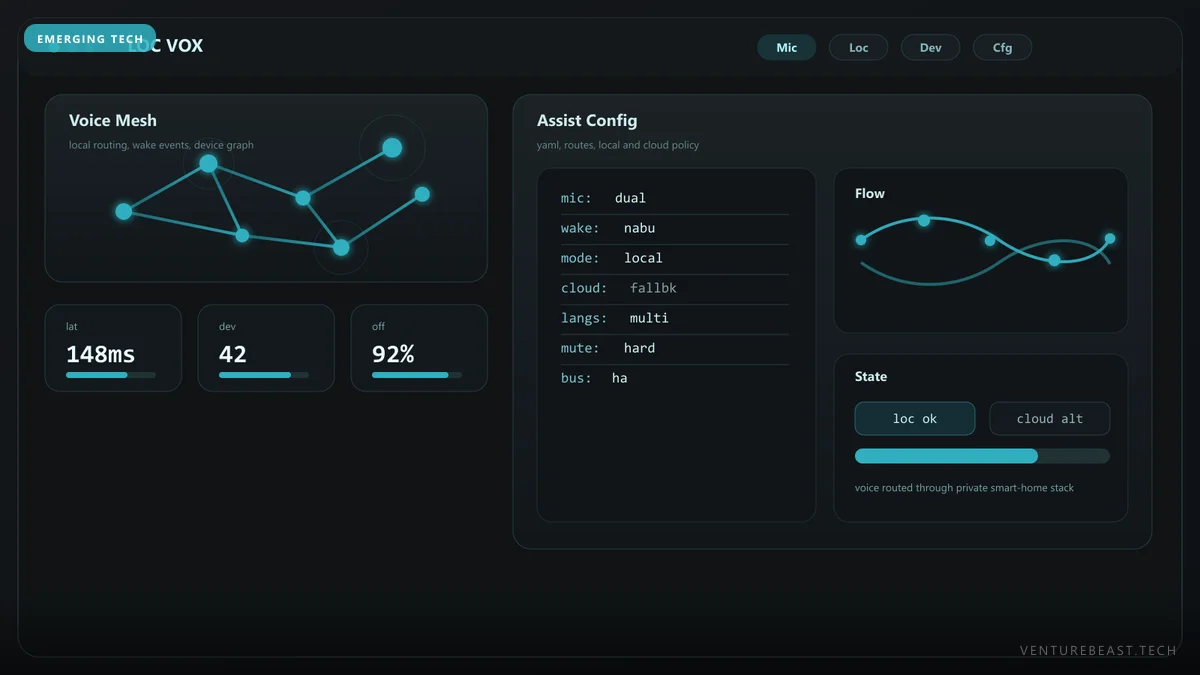
Smart-home voice has been stuck in a bad trade for years: you either accept Alexa and Google convenience plus vendor cloud dependence, or you keep your privacy and lose usable voice control. Nabu, the shorthand many users now attach to Home Assistant's voice stack because of the Okay Nabu wake word highlighted in How-To Geek's October 23, 2025 article, matters because it suggests that trade is finally starting to break.
Quick Answer: Nabu is not a finished Alexa replacement. It is a privacy-first voice layer built around Home Assistant Assist and the Home Assistant Voice Preview Edition. As of April 4, 2026, it already looks credible for local smart-home control, timers, and household commands, but it still lags mainstream assistants on general knowledge, frictionless setup, and mass-market polish.
What Nabu Actually Is
The naming matters. Home Assistant calls the software assistant Assist, and it calls the hardware device the Home Assistant Voice Preview Edition. Nabu is the shorthand that spread because the wake word makes the system feel like a real answer to Alexa. So when readers say Nabu, they usually mean the broader open, local, privacy-first voice stack around Home Assistant rather than one formally branded consumer product.
This is why the right comparison is not one speaker versus another. It is one stack versus another. Home Assistant owns the automation layer. Assist owns speech intent and routing. Voice Preview Edition is the official microphone-and-speaker hardware meant to make open voice easier to adopt and improve. According to Home Assistant's current product page, the device includes dual microphones, an XMOS audio processor, an ESP32-S3, 16 MB of flash, 8 MB of octal PSRAM, a physical mute switch, a Grove port, and 3.5 mm audio output.
Capability also needs clean framing. Nabu is not magic fully local AI squeezed into a tiny box. Home Assistant describes three practical modes: focused local processing for common smart-home phrases on lower-powered hardware, fully local speech processing on stronger hardware, and privacy-scoped cloud processing when you want better accuracy without hosting everything yourself.
Why Local Voice Matters Now
Local voice used to sound like hobbyist ideology. In 2026 it looks like platform strategy. Homes now contain more microphones, more connected devices, and more sensitive routines than they did when Alexa first felt futuristic. Whoever controls the voice interface also shapes the privacy default, the interoperability layer, and the data exhaust created by everyday commands. That is why Nabu matters even if it never becomes the most popular consumer assistant.
Home Assistant's December 19, 2024 launch post framed Voice Preview Edition as the start of an open voice era that could eventually match commercial assistants while supporting languages and user needs big platforms neglect. That ambition is bigger than selling one more smart speaker. Once the stack is good enough, the question for advanced households stops being Which speaker should I buy? and becomes Which control layer do I trust to run my home?
The technical story is what makes the timing credible. Home Assistant now defines the boundaries clearly: low-power hardware can do focused local commands, stronger systems can take on fuller local speech, and Home Assistant Cloud stays available when you need accuracy without hosting heavier speech models. For operators, that honesty matters.
Where Nabu Beats Alexa and Where It Doesn't
Nabu already beats Alexa on one strategic dimension: control. If your house already runs through Home Assistant, Assist sits closer to your entities, scripts, and automations than Alexa ever will. You are not asking a vendor cloud to interpret your home and pass a result back. You are speaking directly to the automation layer you already own.
| Criteria | Nabu / Assist | Alexa | Google Assistant |
|---|---|---|---|
| Local execution | Focused local commands now; fuller local speech needs stronger hardware. | Cloud-first with limited user-controlled local processing. | Cloud-first with limited user-controlled local processing. |
| Privacy posture | Open, inspectable stack with local options and a physical mute switch. | Convenience-first commercial cloud model. | Convenience-first commercial cloud model. |
| Smart-home control depth | Excellent if your devices already run through Home Assistant. | Strong mainstream integrations, less flexible than Home Assistant. | Strong mainstream integrations, but less operator control than Home Assistant. |
| General knowledge and web answers | Improving, but not the platform's strongest mode today. | Still stronger for broad consumer assistant behavior. | Still stronger for broad consumer assistant behavior. |
| Setup complexity | Moderate to high unless you already live in Home Assistant. | Low for mainstream households. | Low for mainstream households. |
| Hardware maturity | Official preview hardware with a clear roadmap, but not mass-market mature. | Mature consumer hardware ecosystem. | Mature consumer hardware ecosystem. |
Privacy is the clearest win. Voice Preview Edition includes a physical mute switch that cuts microphone capture, and the platform is designed around local or privacy-scoped processing rather than default dependence on a commercial cloud. For users who see voice as an always-listening risk surface, that is the core value proposition.
Mainstream convenience still belongs to Alexa and, in many cases, Google Assistant. The Verge's launch coverage captured the gap early: the Home Assistant hardware looked promising, but it was not ready to replace Amazon's polished installed base. That remains true in 2026. Ask Nabu to run your house and it can look sharp. Ask it for the long tail of ambient assistant behavior, broad web answers, and zero-thought setup, and the edges show quickly.
That makes the verdict straightforward. Nabu is superior where the smart home is the product. Alexa remains stronger where the assistant itself is the product.
Who Should Adopt It Now
The best early adopter is not the average family replacing kitchen timers. It is the privacy-minded Home Assistant household, the power user who has already centralized devices, or the builder who wants a voice interface they can inspect and extend. If your priority is local control, language customization, or avoiding permanent dependence on Amazon or Google, Nabu is already worth serious evaluation.
It is also a meaningful signal for teams building on top of the smart-home stack. The official product page openly positions the device as a starting point for open, local, and private voice assistants, and the wider Home Assistant ecosystem now supports connections to popular AI providers as well as local models.
Who should wait? Anyone who wants zero-maintenance setup, the best far-field voice experience across a large home, or the broadest mainstream assistant behavior without tuning. Also anyone who hears fully local and assumes it means open-ended natural language on low-power hardware should wait, because Home Assistant's own documentation is clear that fully local speech processing needs stronger systems.
What to Watch Next
- Language coverage and accuracy. Home Assistant's edge improves as speech models, wake words, and intent handling get better across more languages.
- Better local hardware profiles. If small but capable home servers become the standard host for fully local speech, private voice gets much easier to recommend beyond enthusiast circles.
- A cleaner bridge between home control and general AI. The winning version of this stack will route the right requests to the right layer instead of making users think about which engine should answer.
The bigger strategic point is that voice is reopening as an interface layer. For a decade, the consumer story was that Amazon, Google, and Apple had already won. Nabu suggests that conclusion was premature. They won the first distribution wave, but they did not eliminate demand for private, inspectable, locally governed voice control.
That is why the right way to read Nabu is not Alexa killer. It is credible alternative stack. Those are very different claims, and the second one is now strong enough to matter. If you care about private AI more broadly, the same tension shows up outside the home as well. VentureBeast has already tracked it in pieces on ChatGPT data security and Meta's Play.AI voice technology acquisition.
FAQ
Is Nabu a real Alexa replacement today?
Not for most mainstream households. As of April 4, 2026, it is a strong alternative for Home Assistant users who mainly want smart-home control, timers, and privacy-first design. It is still weaker than Alexa on broad consumer convenience and general assistant behavior.
Can Nabu run fully offline?
Sometimes, but the details matter. Home Assistant supports focused local processing for a limited set of home-control phrases on lower-powered systems, while fully local speech processing needs stronger hardware and supported languages. Home Assistant Cloud remains the easier path for many users who want accuracy without running heavier local speech models.
What hardware is actually doing the work?
The official hardware is the Home Assistant Voice Preview Edition. According to Home Assistant's product page, it uses an ESP32-S3 platform with 16 MB of flash, 8 MB of octal PSRAM, dual microphones, an XMOS audio processor, a physical mute switch, a Grove port, and 3.5 mm audio output. More demanding local speech work can be offloaded to a stronger Home Assistant host.
Why does the price differ between sources?
Because the pricing changed over time. Home Assistant's December 19, 2024 launch post and The Verge's launch coverage both cited a recommended MSRP of $59, while the current official product page lists the Voice Preview Edition at $69 / EUR59 as of April 4, 2026. Use the current official page for live pricing.
Enjoying this article?
Get more strategic intelligence delivered to your inbox weekly.
Enjoyed this article?
VentureBeast.Tech is independent and reader-supported. If this saved you time, you can buy us a coffee — it keeps the research deep and the site ad-light.
Support us on Ko-fi
Comments (0)
No comments yet. Be the first to share your thoughts!