This article may contain affiliate links. We may earn a small commission at no extra cost to you if you make a purchase through these links.
Gemini 3 Agent Skills: Live Docs for Coding Agents
Why static LLMs fail developer tasks, and how Google DeepMind's new Agent Skills close the knowledge gap with a 96.6% success rate.
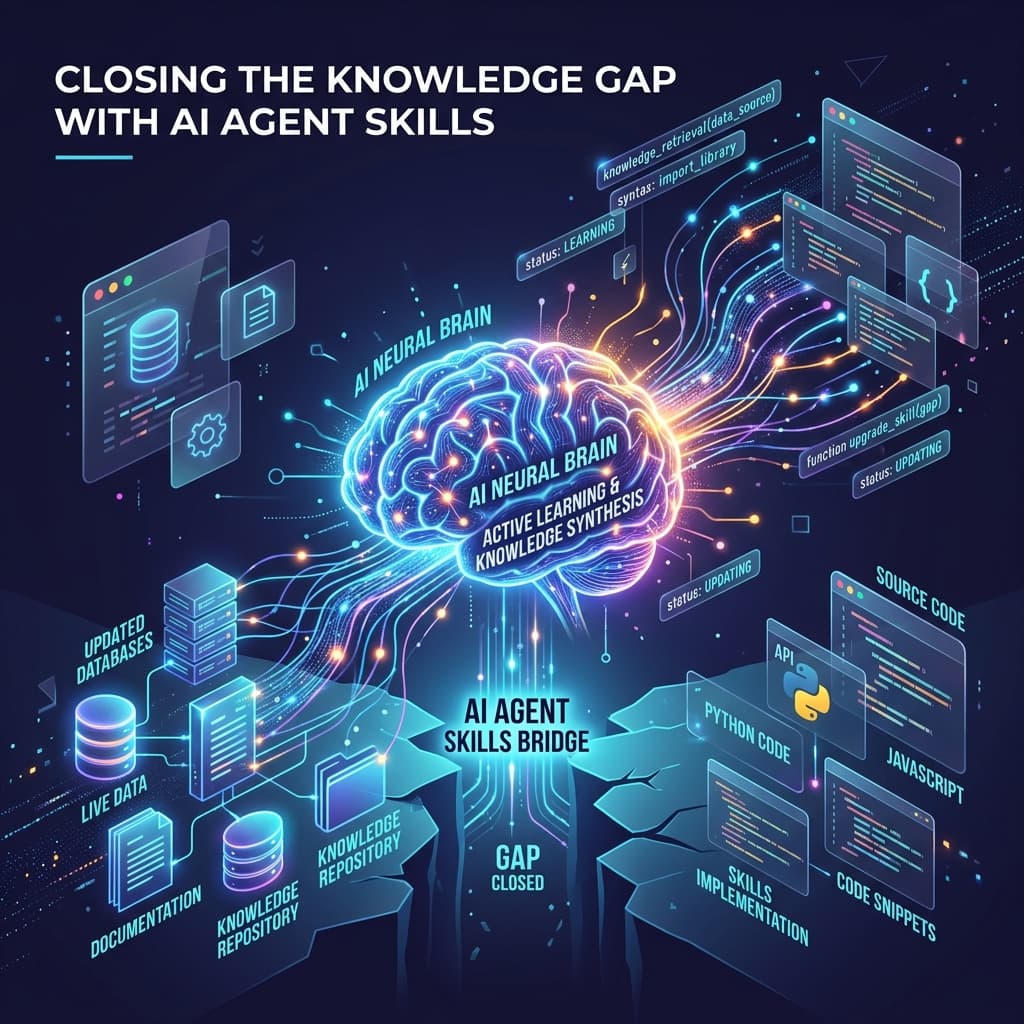
Large language models typically fail when writing code for evolving frameworks. They are trained at a specific point in time, creating a fixed knowledge gap that causes agents to hallucinate deprecated APIs and outdated syntax. But Google DeepMind has introduced a solution: Agent Skills. These lightweight, plug-and-play modules allow the Gemini 3 series to access live documentation, skyrocketing coding success rates from 28.2% to a massive 96.6%.
For engineering teams relying on AI coding teams, this marks the turning point from unpredictable generative experiments to reliable, autonomous development workflows.
The Problem with Fixed Knowledge in Developer Workflows
As software practices innovate rapidly, an LLM’s training data becomes stale within weeks. A model like Gemini or Claude won’t naturally know about yesterday's SDK updates, newly published internal APIs, or shifting best practices like Google's advanced thought circulation patterns.
This is the fundamental crisis in modern AI-assisted engineering. When you instruct an agent to build a feature, treating the LLM as a static database leads to failure. Teams waste thousands of hours debugging code generated from deprecated instructions. While solutions like complex Model Context Protocol (MCP) integrations exist, they often require heavy investment to maintain.
How Agent Skills Close the Gap
Google DeepMind's approach with "Agent Skills" abstracts the complexity of live-data retrieval into a primitive, repeatable structure. To demonstrate this, they built the Gemini API Developer Skill, which gives the coding agent direct access to four critical pillars of external knowledge:
- High-level feature set explanations
- Current model capabilities and SDK specifications
- Live documentation via verifiable, fetched URLs
- Basic, validated sample code for each supported language
Instead of relying on generalized intelligence, the agent uses the activate_skill and fetch_url tools right alongside its base internal memory. It retrieves the exact developer documentation it needs before writing a single line of logic.
The Results: Why Reasoning Models Dominate
When DeepMind tested this framework across 117 complex prompts—ranging from building chatbots to streaming context arrays—the results provided definitive proof that Agent Skills are the future of agentic AI.
| Model Series | Baseline Success Rate | Success with Agent Skill | Performance Gain |
|---|---|---|---|
| Gemini 3.1 Pro (Preview) | 28.2% | 96.6% | + 3.4x |
| Gemini 3.0 Pro & Flash | 6.8% | High (Significant gains) | Massive |
As of Q1 2026, DeepMind notes that Agent Skills dramatically over-index on modern, high-reasoning models. Older generations like the Gemini 2.5 series saw minor bumps from the skills injection, but lacked the reasoning capacity to correctly interpret and apply the freshly fetched documentation. The true value unlock happens when you pair live, actionable instructions with a model intelligent enough to dynamically plan and execute against them.
The Bottom Line for Your AI Strategy
Skills act as a localized, agile alternative to broader context injection methods. But as the architecture of the Agentic Web matures, developers must prepare for a future where autonomous agents dynamically pull the exact knowledge they need, precisely when they need it.
If you're deploying a custom coding assistant today, relying on raw foundation models is an anti-pattern. You must augment your agents with lightweight skills that point explicitly to your internal repository's true documentation. Begin building your own skills framework, monitor your agent's success rate, and ensure your AI strategy leverages live knowledge to stay competitive.
Enjoying this article?
Get more strategic intelligence delivered to your inbox weekly.
Enjoyed this article?
VentureBeast.Tech is independent and reader-supported. If this saved you time, you can buy us a coffee — it keeps the research deep and the site ad-light.
Support us on Ko-fi


Comments (0)
No comments yet. Be the first to share your thoughts!